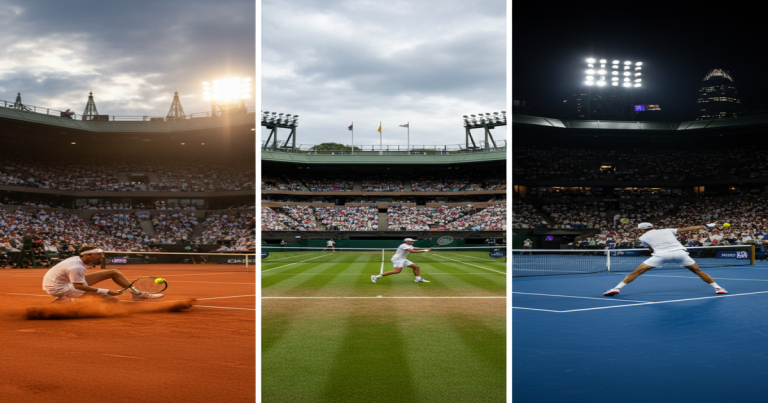
Four Grand Slams. Three surfaces. Completely different tennis. The same player who dominates at Roland Garros may struggle at Wimbledon two months later — not because their game changed, but because the surface rewards entirely different skills. This is the central paradox that makes tennis unlike almost any other sport: the rules are identical, the scoring is identical, even the ball is nearly identical, and yet the game itself transforms depending on what the court is made of. Understanding why requires a look at some physics — and a look at the players who mastered, and sometimes stumbled on, each particular patch of ground.
Clay Courts: The Patient Game at Roland Garros
Roland Garros is played on crushed red brick clay — a surface that fundamentally changes the physics of every ball that lands on it. Clay has a high coefficient of friction, which means it grips the ball on impact and absorbs much of its horizontal momentum. The result: the ball slows down dramatically and bounces high, roughly 23% higher than on grass according to International Tennis Federation measurements. Where a ball might skid through on grass at ankle height, that same ball on clay will sit up and invite a player to load a heavy topspin response from shoulder height.
This physics directly rewards a specific style of play. Baseline specialists with heavy topspin groundstrokes thrive on clay because topspin becomes even more dangerous: the exaggerated bounce pushes opponents further behind the baseline, making it harder to attack and easier to defend. Physical endurance matters too — rallies run longer because nothing is ending cheaply on this surface. A serve that would be an outright winner on grass becomes a manageable return on clay. Big servers who rely on unreturnable first balls see that weapon dulled considerably.
No player in the history of the sport has exploited these conditions the way Rafael Nadal did. His 14 French Open titles — a record at any Grand Slam for any player, male or female — were built on a combination of extreme topspin (his forehand averaged around 3,200 RPM), exceptional footwork, and an almost unnatural ability to cover the court and construct points over extended rallies. Nadal’s record at Roland Garros across his career was 112 wins and 4 losses. To put that in context: he won 14 out of 15 tournaments he entered. On clay overall, Nadal won 90.5% of his matches.
Yet the greatest player of a different generation — Roger Federer — captured the French Open exactly once, in 2009. Federer’s game, built on flat precision and aggressive shot-making, was routinely neutralized by a surface that gave opponents time to reset. His serve didn’t produce free points as reliably. His flat backhand, one of the best strokes in the history of the game, sat up at a hittable height rather than skidding through. Federer was, at various times, ranked number one in the world while failing to win in Paris. The clay simply said no.
Grass Courts: Speed, Skid, and Serve at Wimbledon
Wimbledon’s grass courts sit at the opposite end of the spectrum. Where clay grips and slows, grass releases and accelerates. The coefficient of restitution on grass is approximately 0.75 — significantly lower than clay’s 0.85 — which means the surface absorbs more energy on impact and returns less. The ball stays low, skidding through at a flat angle rather than kicking up. A ball landing on grass at 16 degrees rebounds at roughly the same angle; on clay that same ball might fly off at 20 degrees or more. Reaction time for returners is reduced by approximately 18% compared to clay. Points end faster. Winners happen earlier in rallies.
In this environment, the serve becomes the most powerful weapon in tennis. A well-placed first serve on grass — particularly wide in the deuce court or into the body — doesn’t just start the point favorably; it can effectively end it before the receiver can establish any position. Serve-and-volley tennis, largely extinct on modern hard courts and clay, still made sense at Wimbledon into the early 2000s because the serve set up an approach so easily that finishing at the net was the highest-percentage play. Players with clean, aggressive ball-striking who could neutralize the return game thrived. Grinders who needed time to build points suffered.
Pete Sampras built the most dominant Wimbledon record of the modern era on exactly these principles. His booming serve produced outright aces or short, weak returns; his crisp volley finished. He finished his Wimbledon career with a 63–7 record — a 90% win rate — and seven titles, never losing a final at the All-England Club. John McEnroe, with his serve-and-volley genius and exceptional touch at net, won three Wimbledon titles. Roger Federer later became the grass court standard-bearer of his generation, winning eight titles at SW19 and mastering grass through a combination of aggressive baseline play and opportunistic net approaches.
The counterexample that still seems slightly miraculous is Bjorn Borg. A classic clay-court baseline player — not a serve-and-volleyer — Borg won five consecutive Wimbledon titles from 1976 through 1980 through sheer physical domination and an ability to adapt his topspin game to lower, faster conditions. His success on grass was considered an outlier even at the time. More typical was the trajectory of players like Marat Safin — a hard-court Grand Slam champion (two majors, one on hard, one on hard) with one of the most powerful games of his era — who could never crack Wimbledon’s second week despite having the raw tools on paper.
Hard Courts: The Middle Ground at the US Open and Australian Open
Hard courts are the most commonly played surface worldwide, and they sit between clay and grass in terms of pace and bounce consistency. Both the US Open (played on Laykold at Flushing Meadows) and the Australian Open (played on GreenSet in Melbourne) use acrylic hard court surfaces layered over concrete or asphalt. The bounce is predictable — far more uniform than grass, which can produce variable hops depending on the condition of individual patches of turf — and the pace is medium to medium-fast.
Interestingly, the two hard-court Slams aren’t identical. The Australian Open surface is officially rated Category 4 (Medium Fast) by the ITF, while the US Open’s Laykold rates as Category 2 (Medium Slow). Melbourne plays slightly faster; New York’s surface, while feeling quick in the heat, actually allows more spin to develop. The Australian Open’s conditions — heat, pace, physical demands in a compressed early-season schedule — tend to favor big athletic ball-strikers. The US Open’s louder, more chaotic atmosphere and slightly heavier conditions can favor players who keep their nerves in check as much as those who play the most physical tennis.
Hard courts reward a wider range of playing styles than either grass or clay, which is part of why the hard-court Grand Slams have produced the most varied champion lists. Novak Djokovic, the all-time record holder with 24 Grand Slam titles, built much of his dominance on hard courts — his exceptional return game, precision groundstrokes, and extraordinary defensive retrieval work on a surface that provided consistent, hittable bounces. Serena Williams’ combination of serve power and groundstroke aggression made hard courts her natural home (she won 13 of her 23 Grand Slams on hard). Andre Agassi, one of the greatest returners the game has produced, won both the US Open and Australian Open on hard courts.
The struggles on hard courts tend to be subtler than surface-specific failures on clay or grass. Players who rely heavily on net approaches can be exposed by the more consistent, predictable bounce that allows better returners to pass them cleanly. Serve-and-volleyers who thrive at Wimbledon often find the extra half-second of court time on hard courts gives opponents just enough time to react. And players whose games depend on clay’s extended rallies — pure grinders who lack a pace-setting weapon — can be overwhelmed by the more aggressive play that hard courts invite.
Why Surface Diversity Makes Tennis Uniquely Compelling
No other major sport changes its fundamental playing conditions across its most prestigious events. The NFL plays on grass or turf but the physics are identical. The NBA plays on hardwood everywhere. Baseball’s parks vary, but the game’s core physics are consistent. Tennis alone asks its champions to master completely different forms of the same game — and then tests them back to back within a single calendar year.
The result is that tennis has no single template for greatness. The complete player, capable of winning on all three surfaces, is rare enough that only seven men in the Open Era have achieved a Career Grand Slam — Agassi, Connors, Federer, Nadal, Djokovic, Wilander, and most recently Carlos Alcaraz. Most champions carry surface vulnerabilities that the calendar eventually exposes. Understanding those vulnerabilities, and understanding the physics that create them, transforms a tennis fan from someone who watches what happens into someone who understands why.
When you see a world-class player struggling at a Slam where they should, on paper, be a contender — look at the surface first. The court isn’t neutral. It never was.