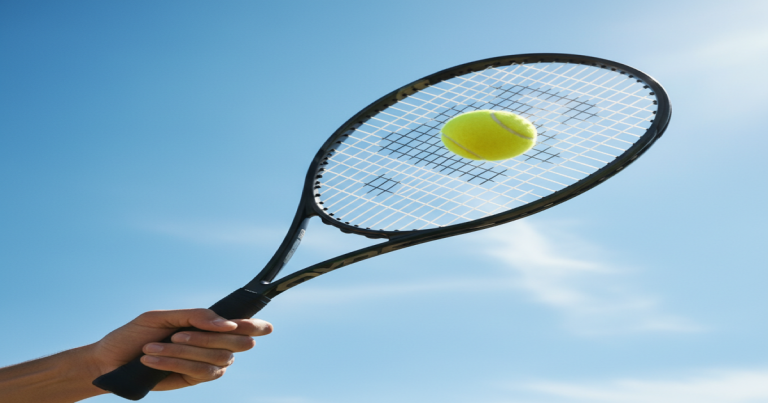
The serve is the only shot in tennis where you control every variable before the ball moves. Stance, grip, toss position, swing path — all of it is yours to set. Which means when your serve breaks down, the answer is inside your own mechanics, not across the net.
Most recreational players try to fix their serve by adding things — more leg drive, more wrist snap, a bigger trophy position. Week 1 of the 30-Day Serve Project does the opposite. It strips the motion down to one variable: contact point. Get that right, and every other adjustment you make in Weeks 2, 3, and 4 will actually hold. Skip it, and you’re building on a shifting foundation.
Why Contact Point Breaks Down
Inconsistent contact on the serve almost always traces back to one of three causes — and most players have at least two of them working against them simultaneously.
The toss placement is off. A toss that drifts too far back, too far to the side, or too low forces you to adjust mid-swing. Your arm chases the ball instead of meeting it. The result is contact made at a different height and angle every single time, even if your swing feels the same. A reliable contact point starts with a reliable toss — but don’t let that send you into toss drills yet. This week, we’re going to expose your toss problem through the contact point work rather than fix it in isolation.
Early arm bend. Watch slow-motion video of most club players and you’ll see the hitting elbow tucking in before the racket reaches the ball. That bend shortens your reach, drops your contact point by six to eight inches, and removes the clean snap that creates both power and directional control. It usually happens because the player is rushing — subconsciously trying to “get to the ball” rather than trusting that the toss will wait for them.
Rushing the motion. The serve has a natural rhythm: toss and turn together, pause at the peak, then drive up and through. When players rush, the hitting arm starts its forward swing before the toss arm has finished its job. The two motions collide, the contact point drops, and the arm bends to compensate. Slowing the sequence — especially the pause between toss peak and racket acceleration — fixes more contact problems than any technical adjustment.
Week 1 Drills: Three Reps a Day Toward a Repeatable Contact Point
These three drills are designed to be done in order, in a single 15-minute session. You’ll need your racket, a full can of balls, and access to a court or a clear wall. No partner required.
Drill 1: The Statue Catch
Setup: Stand at the baseline in your serving stance — sideways to the net, feet shoulder-width apart, weight balanced. Hold your racket in your non-dominant hand. With your dominant (hitting) hand, toss the ball as you normally would for a serve.
Let the ball reach its peak. At the peak, raise your hitting arm fully — elbow straight, fingers extended — and catch the ball at the highest point you can reach without leaning or bending at the elbow. Your arm should look like you’re reaching for something on a high shelf, not like you’re swatting at a fly.
Reps/Sets: 15 tosses per session. Don’t rush. Between each toss, reset your feet and stance completely.
What to feel for: The ball should land in your palm with your arm at full extension and your shoulder rotated slightly forward. You want to feel a slight stretch across your chest and shoulder — that’s your body telling you it’s in the right hitting position.
What a failed rep looks like: You bend your elbow to reach the ball. The ball lands on your fingertips rather than your palm because it drifted too far back. Your shoulder stays square to the net instead of rotating toward the toss. Any of these means the toss is inconsistent, the arm is bending early, or both. Don’t “fix” the catch — just count the miss and toss again. The data matters more than the correction at this stage.
Drill 2: Shadow Swing with Freeze
Setup: This drill uses your racket but no ball. Take your full serving stance at the baseline. Go through your full serve motion — toss (no ball, just the arm motion), trophy position, racket drop — and then drive up through contact and freeze.
The freeze is everything. Stop your racket at the exact moment of imaginary contact: arm fully extended overhead, racket face pointing toward the target, wrist not yet pronated. Hold that position for a three-count. Look up at your hand. Is your elbow straight? Is the racket face in front of your body or behind it?
Reps/Sets: 20 swings per session. Slow is better than fast here. If you can’t stop at contact cleanly, you’re swinging too hard.
What to feel for: A momentary “locked” sensation in your arm at full extension, as if you’ve reached the top of a pull. The shoulder of your hitting arm should be higher than your ear. Your weight should have shifted forward through the motion, not stayed back on your rear foot.
What a failed rep looks like: You can’t stop the racket at contact — it blows right through the freeze point. This means your arm bent early and the power has already discharged before you hit the ball’s location. Also watch for stopping with the racket behind your head: that means your contact point would have been too far back, and you’d be serving into the fence in a real rally.
Drill 3: Live Ball, One Bounce
Setup: Stand two feet inside the baseline — closer to the net than your normal serving position. Bounce a ball on the court in front of you and, as it rises to approximately head height, hit it with a compact serve motion focused entirely on making contact at full arm extension. Don’t try to hit hard. Don’t aim for a specific box yet. Your only goal is to make contact at the highest point of your comfortable reach.
The one-bounce format slows the whole sequence down. The ball is coming to you on a predictable arc, which removes the toss variable entirely. That lets your arm learn the extension position without fighting an unreliable toss at the same time.
Reps/Sets: 20 balls per session. After 10, step back to the baseline and try to recreate the same feeling with a live toss — 10 more balls from your actual serve position.
What to feel for: A solid, centered strike where the ball compresses against the strings at the top of your swing rather than mid-swing. There’s a distinct sound difference between contact at full extension (a clean pop) and contact with a bent elbow (a muffled thud). Train your ear alongside your arm.
What a failed rep looks like: The ball goes sharply into the net. This almost always means you let the bounce peak pass before hitting — your arm extended, but too late, and you’re pushing the ball downward. Reset and meet the ball slightly earlier in its arc.
Week 1 Schedule
Five sessions this week, 15 minutes each. That’s it — don’t try to turn this into a full serve practice. Focused repetition on a single variable beats an hour of unfocused serving every time.
Each session runs in order: Statue Catch (15 reps) → Shadow Swing with Freeze (20 reps) → Live Ball, One Bounce (20 reps). Rest 30 to 60 seconds between drills. After your last 10 baseline serves in Drill 3, note mentally whether your contact felt higher and more consistent than it did in rep 1 of that session. That trend — even a small one — is progress.
If you have access to a hitting partner or a ball machine, use them for the second half of Drill 3, but it isn’t necessary. A hopper of balls and 15 minutes of honest, unhurried work will get you where you need to go.
What’s Next: Week 2 — The Toss
Once you’ve built a reliable sense of where your contact point needs to be, everything else in the serve has to be redesigned to feed it. Week 2 isolates the toss — not the mechanics of how your arm moves, but where the ball needs to land in space for your new contact point to work consistently. You’ll find out quickly whether your current toss is helping you or fighting you. Most players discover it’s been fighting them for years.
Do the Week 1 work first. Come back when you’ve logged all five sessions.