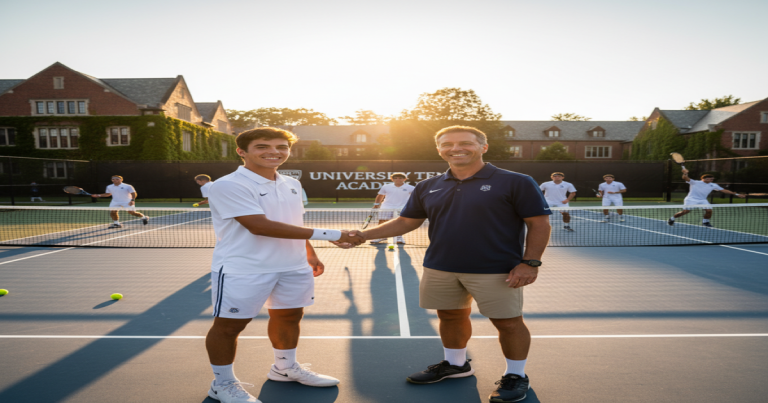
If you’ve spent the last two years tracking your child’s USTA junior ranking like a stock portfolio, you’re not alone. But if ranking is the primary lens you’re using to gauge their college tennis prospects, the data suggests you may be optimizing for the wrong thing. Coaches across all NCAA divisions consistently say that what families prioritize going into recruiting conversations and what coaches actually need from a recruit are meaningfully different. This article breaks down the gap, one factor at a time.
Myth #1: Ranking Is the Deciding Factor
What parents believe: A high USTA junior ranking or strong TRN (Tennis Recruiting Network) standing is the ticket to a roster spot.
What coaches actually say: Rankings and ratings — particularly the UTR (Universal Tennis Rating) and the ITA’s adopted World Tennis Number (WTN) — are used as a filter, not a final verdict. They help coaches identify which players fall within their program’s competitive range. But the rating only gets a player into consideration. Everything else determines whether they get an offer.
The ITA College Connect tool (launched in 2024) makes this concrete: it matches a recruit’s WTN against a team’s average WTN to surface programs across more than 1,700 college programs spanning DI through JUCO levels. The purpose is finding the right fit — not the highest-ranked player.
Actionable guidance: Use the ITA College Connect tool to identify 15–20 programs where your child’s WTN is competitive. Cast a wider net across divisions. A well-matched DII or DIII program will develop your child more than a benchwarming spot at a DI school that’s a reach.
Myth #2: Character Is a Nice-to-Have
What parents believe: A good kid with decent manners will check the character box. Coaches really care about the forehand.
What coaches actually say: In a survey of 30 college tennis coaches published by Tennis Files, character traits — honesty, loyalty, the ability to encourage teammates — ranked as highly as technical skill for final roster decisions. Multiple coaches stated they would rather lose matches than recruit a player who disrupts team culture.
College tennis is a team sport played by athletes who trained as individuals. A coach investing scholarship money is also investing four years of locker room dynamics. A player with a high UTR who blames conditions for losses and sulks on the bench creates a tax on everyone around them.
Actionable guidance: Coaches routinely call a recruit’s junior coach before extending an offer. Make sure that coach knows your child well — has seen them in adversity — and can speak specifically to how they handle losing, respond to correction, and treat teammates. That phone call is often more influential than tournament results.
Myth #3: GPA Is Just a Checkbox
What parents believe: As long as my child clears the NCAA minimum (2.3 GPA in 16 core courses for DI), academics aren’t a real factor.
What coaches actually say: The NCAA floor is not the ceiling coaches evaluate against. Academic profile signals work ethic and long-term coachability. A student who navigated a rigorous course load while competing in juniors demonstrates time management and resilience — exactly what a coach needs from someone balancing practice, travel, and a full class schedule. Practically, at many schools a player’s academic profile affects admissibility regardless of athletic interest. Coaches sometimes lose a top target not because of tennis but because admissions won’t clear the student.
Actionable guidance: If your child has a strong GPA, lead with it in initial outreach. It signals that they can handle the program without academic risk. If academics are a weak spot, be candid early — coaches respect honesty more than discovering a problem midway through an official visit.
Myth #4: Good Play Will Attract Attention on Its Own
What parents believe: If the results are there, coaches will find them.
What coaches actually say: At every level below elite DI programs, coaches are not combing through junior draws for undiscovered talent. They are reviewing the players who reached out to them. The USTA and ITA both make this explicit: college tennis recruiting is largely prospect-initiated. Waiting passively for a coach to find your child is not a strategy — it is an opt-out.
NCAA DI rules permit coaches to initiate contact after June 15 of the student’s sophomore year. But recruits can contact coaches at any point before that. An introductory email in freshman or sophomore year is not only allowed — it is expected at programs that fill rosters 12–18 months before a signing date.
Actionable guidance: The first email should be short (4–6 sentences), specific, and written by the player — not the parent. Include: graduation year, WTN or UTR rating, GPA and intended major, a link to match video, and one genuine sentence about why that specific program is appealing. Generic mass emails get deleted. Coaches notice when a recruit has actually looked at their program.
Myth #5: The Campus Visit Is an Audition
What parents believe: Your child needs to perform — on the court and in conversation — to close the deal.
What coaches actually say: The visit is a mutual evaluation, and the recruit’s curiosity matters as much as their performance. Coaches want to see a recruit who is genuinely thinking about fit — asking thoughtful questions of current players (both top-of-roster and bottom), engaging with non-tennis people on campus, and demonstrating that they have considered what they actually need from the next four years.
Coaches are also watching how parents interact with their child. A parent who corrects answers, speaks for them, or visibly manages the visit sends a signal about what communication with that family will look like over four years. The message coaches consistently give: let your child lead.
Actionable guidance: Before the visit, prepare 5–8 genuine questions together with your child. Then step back. During coach conversations, resist the urge to fill silence. Let your child engage with the players independently. Their ability to navigate that room without you is exactly what the coach is quietly evaluating.
The Recruiting Timeline That Actually Matters
Freshman and Sophomore Year: Build the player profile — WTN and UTR accounts active, highlight video filmed, academic record tracked. Begin researching programs and send introductory emails. Attending ITA Summer Series events can provide exposure to college coaches in a sanctioned setting.
June 15 After Sophomore Year: For NCAA DI, this is when coaches can legally initiate contact by phone, text, or DM. If you’ve done prior outreach, this date becomes a follow-up checkpoint, not a cold start.
Junior Year: Official visits can begin August 1 of junior year for DI programs. Most serious recruiting conversations and verbal commitments happen here. Off-campus evaluations by coaches are also permitted after this date.
A note on senior year: Programs fill spots on their own schedule. A senior-year scramble for a DI spot that was never realistically in range wastes everyone’s time. DII, DIII, and NAIA programs recruit on longer timelines and produce excellent four-year experiences — approach them as choices, not consolation prizes.
The Bottom Line
College tennis coaches are looking for players who will make their program better in ways that extend well beyond what a ranking measures. The ITA’s own College Connect framework is built around fit — competitive fit, academic fit, cultural fit. When the ITA and USTA both publish guidance that leads with coachability, character, and communication, they are reflecting what coaches told them.
Families who navigate this well share one trait: they treat recruiting as a search for the right fit, not a competition for the highest-prestige offer. That shift — from performance anxiety to genuine curiosity — tends to produce better outcomes on the court and in the classroom.